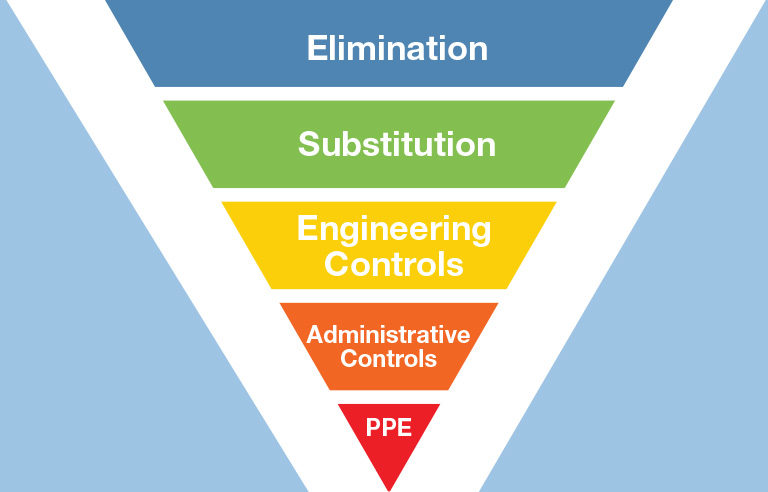
In the tree care industry, safeguarding the well-being of workers, clients, and the public is of great importance. The nature of this work is inherently dangerous as it involves a variety of risks and hazards, such as working at heights, working with heavy machinery, and/or working with sharp equipment all the while navigating many environmental factors that can be completely hidden from view. To ensure a safe and secure work environment, the industry relies on a powerful safety framework known as the Hierarchy of Controls. This visual guide, depicted as an inverted pyramid, offers an effective approach for controlling workplace hazards and protecting employees, clients, and others.
1. Elimination – Physically Remove the Hazard
At the top of the Hierarchy of Controls lies the most effective strategy – elimination. This entails removing the hazard at its source. For tree care operations, it may involve altering the work processes to avoid climbing a decaying tree, lifting heavy objects, or using sharp tools. Elimination is the preferred solution as it prevents any exposure to risk from occurring. However, implementing this measure for existing processes can be challenging, and when possible it can require significant changes in equipment and procedures. Regardless of the feasibility of elimination for existing processes, it serves as the ultimate goal for risk reduction, as the closer to achieving it we get the less exposure exists ensuring the highest level of protection.
2. Substitution – Replace with Safer Alternative
Substitution involves replacing hazardous materials, tools, or processes with safer alternatives. For instance, the tree care industry can minimize risk by utilizing biodegradable oils, cleaner fuel, or battery powered tools. It can also replace harmful chemicals used in Plant Health Care with Integrated Pest Management procedures and natural oils or soaps. By adopting this approach and investing in state of the art equipment and in the training for advanced climbing techniques tree care professionals can minimize their exposure to risk as well as reduce potential harm to others and the environment. Substitution is a valuable approach, particularly when complete elimination is not achievable.
3. Engineering Controls – Isolate People from Hazards
The third level of the hierarchy involves engineering controls that physically isolate workers from hazards. Examples of this include implementing proper signage and barriers isolating tree care professionals or others from specific hazards associated with a work zone. Leveraging resources from agencies like the Tree Care Industry Association (TCIA), the International Society of Arboriculture (ISA), and the National Institute for Occupational Safety and Health (NIOSH), as well asl pursuing further education and training to help tree care professionals have the knowledge and tools needed to minimize risk. These measures act as physical barriers between workers and hazards, reducing the likelihood of accidents and injuries.
4. Administrative Controls – Change Work Practices
Administrative controls involve the implementation of procedures and policies to manage risks effectively. Measures like rotating job duties and responsibilities to limit exposure to situations that breed complacency, scheduling work efficiently so as to lessen the potential for fatigue, and restricting access to dangerous areas can be effective. While administrative controls may not eliminate hazards, they can significantly reduce risks and enhance safety awareness among the workforce, and while these controls may require continuous oversight and training, making them relatively expensive to sustain they are integral to the development of a culture of safety and common sense within the company.
5. Personal Protective Equipment (PPE) – Worker Protection
At the base of the Hierarchy of Controls is personal protective equipment (PPE). While essential, PPE should not be relied upon as the only solution to mitigating risk. PPE acts as a final line of defense, providing individual protection to workers in situations where other control measures are insufficient (prioritizing elimination and substitution over PPE is always preferred). Nevertheless, PPE remains an important option to ensure worker safety, especially when other controls are not feasible. In the tree care industry, PPE may include helmets, gloves, safety goggles, ear protection, and saw protection, and its effectiveness relies on proper training, fit, and consistent usage.
Key Concepts To Consider
1) Time and Proximity: Hazards addressed as early as the initial site visit ensure better control and a safer work zone. As a homeowner or manager of trees, this is important to know when vetting companies. A thorough inspection of the tree(s) and surrounding landscape is a sure sign the estimating Arborist is conducting a visual risk assessment, and taking notes on how to mitigate any hazards present.
2) Passive vs. Active Controls: Controls may require varying degrees of worker involvement; the farther up the hierarchy, the less active participation is necessary. As a well oiled machine requires little attention the same can be said in regards to a tree care provider that operates safely and efficiently.
3)Trust Factor: As controls move down the hierarchy, reliance on human actions increases, necessitating a stronger sense of trust between tree care professionals and the homeowner. This trust is key as the entire crew operates not just for their personal safety, but for the safety of their fellow crew members. Furthermore, the homeowner is entrusting of them to do what is right not only for the tree(s) but for the property as a whole; thus when there is trust within the crew there will be trust with the homeowner as well.
Using the Hierarchy of Controls:
Companies who effectively use the hierarchy to identify and evaluate control methods ensure safety. Having workers involved in hazard identification and control is invaluable, not just to the company but to the client as well. Developing hazard control plans and evaluating the effectiveness of controls are essential steps in creating a safer work environment. By integrating the Hierarchy of Controls into tree care practices, we can substantially reduce the risk of injuries, minor or severe. Emphasizing elimination and substitution, where feasible, will lead to inherently safer systems. Ultimately, a concerted effort to prioritize safety at every level will foster a more secure and thriving tree care industry.