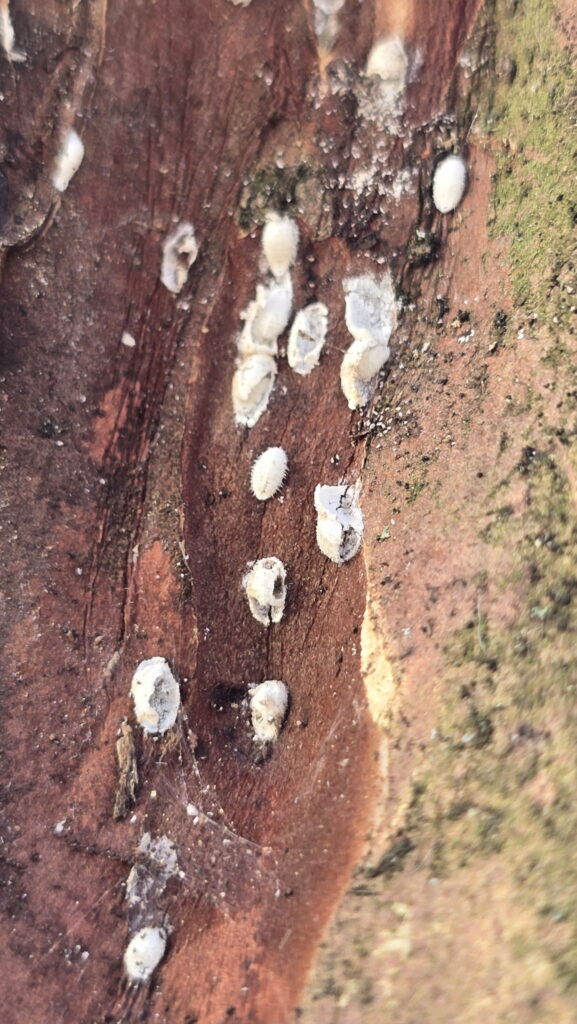
Is your crape myrtle covered in black a powdery substance? Are the branches speckled with little white cottony structures?
You’re likely dealing with Crape Myrtle Bark Scale (CMBS) (Acanthococcus lagerstroemiae). CMBS is an invasive pest that feeds on the sap of your crape myrtle and leaves behind a sticky residue called honeydew. In turn honeydew offers the ideal growing conditions for sooty mold, which is the black powdery fungus that covers your tree and anything below that the honeydew falls on.
What does this mean for your tree(s)?
Well, thankfully the black coating won’t hurt your crape myrtle but it is a symptom and a clear indicator of bark scale. CMBS weakens your tree over time by disrupting the physiological function of nutrition transport by feeding directly from the vascular tissue of the tree.
Left untreated, CMBS reduces the available sugars and nutrients required for growth. This typically is seen through reduced plant vigor, stunted growth, and fewer, smaller blooms. These symptoms worsen year after year, ending in removal or plant death.
What should you do next?
First – Start with a professional evaluation
At Barren Tree Solutions, we take a measured, science-based approach:
One of our Certified Arborists will inspect your tree(s) to confirm the presence of CMBS and identify any contributing stress factors (soil conditions, site limitations, improper pruning, etc.), and they will take the necessary measurements in order to calculate chemical dosage and submit a proposal for treatment. We then schedule the treatment for the proper growing degree day window in which the treatment will have the greatest efficacy in gaining control over this pest.
Second – Avoid improper maintenance practices
CMBS is a pest of opportunity. It thrives on stressed trees! Bad practices such as topping (crape murder), piling mulch up against the trunk (volcano mulch), or using landscape fabric and rocks instead of mulch are just some of the many stressors we see. Combine any environmental stress with topping and you will guaranteed invite scale onto you tree… you create the exact conditions where pests like CMBS take hold.
How do we treat it?
The most effective method in managing CMBS is through the use of systemic insecticide treatments, timed around around the crawler stage. Depending on the situation, treatment is made through either a soil applied systemic insecticide for uptake through the roots, or a targeted bark applications for absorption through the vascular tissue.
This is not a one-time fix, it requires management over time. Our goal is to not just treat and leave, but to help guide you in restoring the tree health, reduce pest pressure long-term, improve flowering and structure, and protect your landscape investment.
If your crape myrtles are showing signs of CMBS, don’t wait for it to spread!
Give us a call and let us build a plan with you on getting your trees back to being healthy.
Call our office today 703-586-9691 or email us to schedule your treatment today.